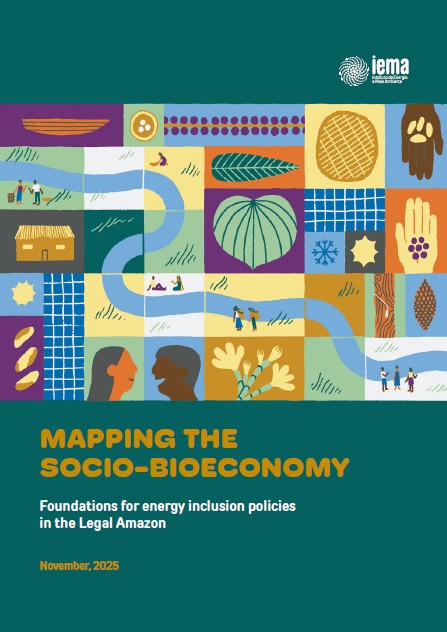
The report “Mapping the Sociobioeconomy: Foundations for Energy Inclusion Policies in the Legal Amazon” brings together, for the first time, quantitative and qualitative evidence on the region’s extractivist territories, their production, and access to electricity, based on data from the Brazilian Institute of Geography and Statistics (IBGE). The study highlights the essential role of forest-dependent families in income generation, food security, and environmental conservation, showing that extractivist activities and family farming sustain the sociobiodiversity economy — or sociobioeconomy.
By analyzing the relationship between plant production, energy exclusion, and the productive use of electricity, the report shows that the lack of access to electricity limits the processing of forest products and the productive inclusion of these populations. The study also identifies structural and informational bottlenecks that hinder effective public policies for the sociobioeconomy, reinforcing the importance of data-driven decisions to promote a development model that keeps the forest standing and ensures the well-being of local communities.